SOUND LAB / 2010
Aktion
for 12 saxophones (1.2.3.3.2.1)
Commissioned by the C.G.S. (Compañia General de Saxofones) of the Conservatori Superior de Música de les Illes Balears.

INSTRUMENTATION
12 saxophones (1.2.3.3.2.1)
COMMISSION
Compañia General de Saxofones
PREMIERE
Babel concert, Aula Internacional de Saxofón
DATES
28 and 29 January 2011
Recording
Action painting
Artists such as Jackson Pollock, Franz Kline, Yves Klein, and Willem de Kooning pioneered a new way of conceiving their artworks. Originating from abstract expressionism and heavily influenced by other artistic movements like Fluxus, conceptual art, art installations, and Land Art, they developed a novel approach to art creation. The creative act itself takes precedence, relegating the final result to a secondary position. The making of pictorial works transforms into a performance.
PART 1
Jackson Pollock
Pollock, the creator and developer of the dripping technique, turned the act of painting into an internal performance where the action of painting and creating is paramount, not the final outcome. In Aktion, I translate the idea of dripping through slap tonguing on the saxophones, representing the drops, and the threads of spilled paint connecting one drop to another. Each falling drop manifests as a slap, and its spectrum resonates from this impact.
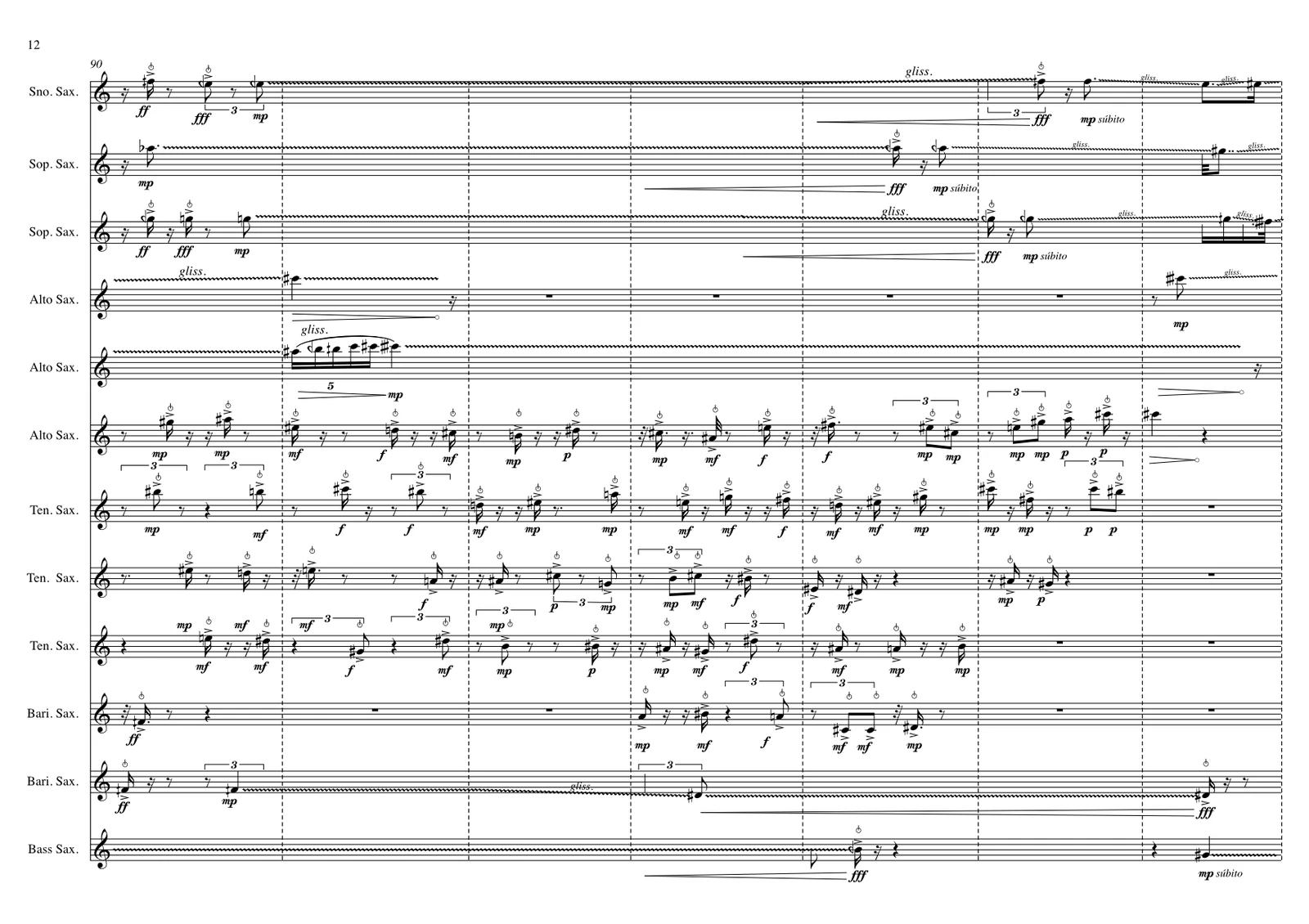
Aktion / Jackson Pollock
As in Pollock’s paintings, the constant addition of material gradually forms a canvas filled with overlapping layers. In the musical piece, the slaps progressively evolve into sustained sounds, while new impulses continually overlay and obscure the existing sounds.
PART 2
Franz Kline
A friend of Jackson Pollock and Willem de Kooning, Franz Kline is another abstract painter, known for a simpler style featuring large black and white strokes. Often compared to Japanese calligraphy but inspired by bridges, tunnels, and architectural structures, his works maintain a fresh spontaneity.
Aktion / Franz Kline
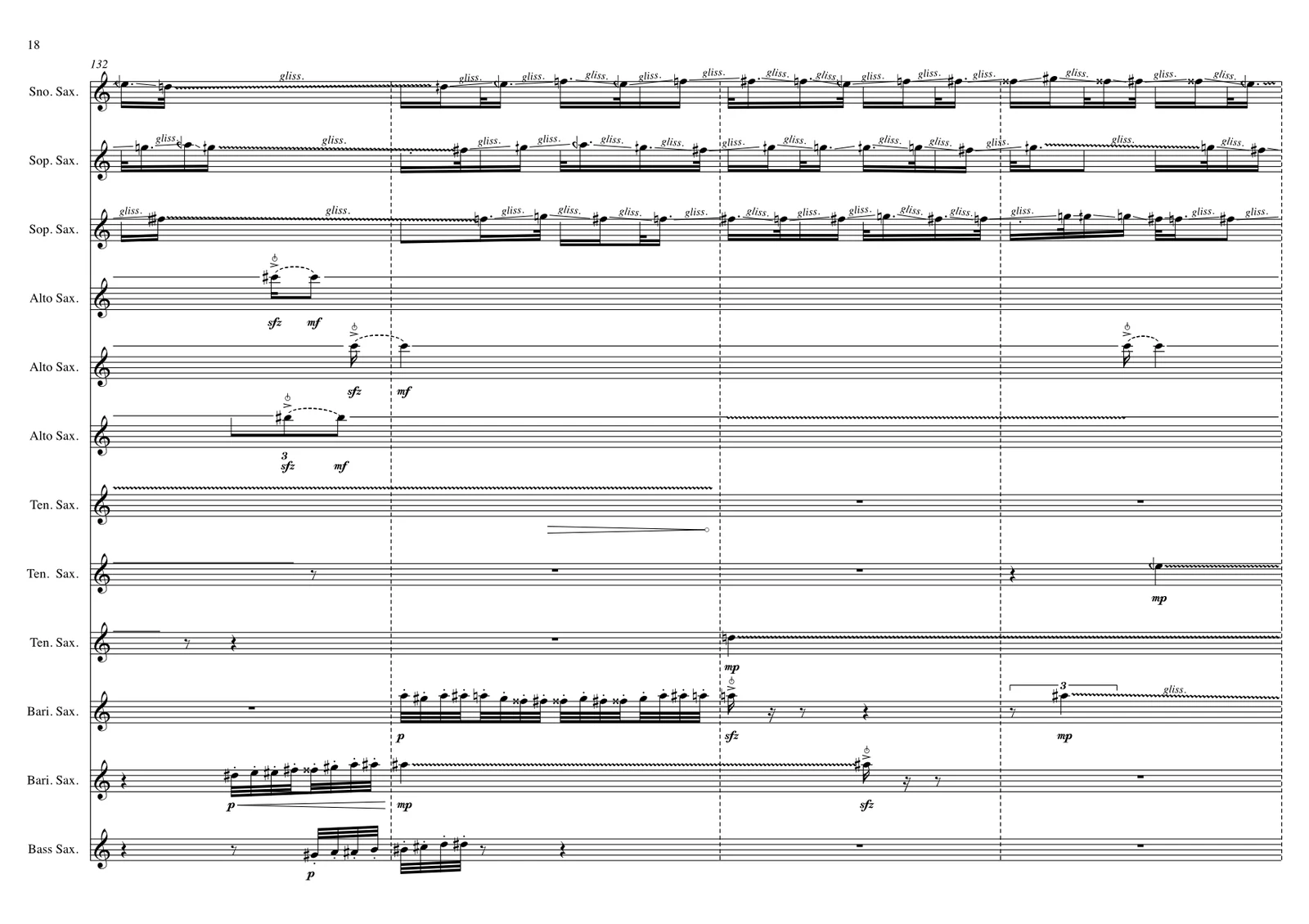
The harmonic material for this section is formed by superimposing and horizontally arranging the spectra of G#1 and A1 (which will appear fully in the final part). Three groups of notes, formed as dense, sustained bands of sound (horizontally extended clusters), simulate the thick brushstrokes characteristic of Franz Kline’s style.
Each cluster appears in a different group of saxophones, presented forcefully and without vibrato, always indicating a direction through glissando movement.
Different thick brushstrokes appear in various sections of the ensemble – rising, falling, crossing, and finally merging onto the hypothetical canvas, which gradually becomes fuller. This leads to a dense, blurred texture that introduces the final part.
PART 3
Yves Klein
A member of Nouveau réalisme, Klein was a significant figure in Performance art. He is renowned for his monochrome works, eventually focusing primarily on a shade of blue he patented as International Klein Blue (IKB). He is also known for using nude female models, covered in paint, to mark the canvas with their bodies while an instrumental group performed music for an observing audience.
Aktion / Yves Klein
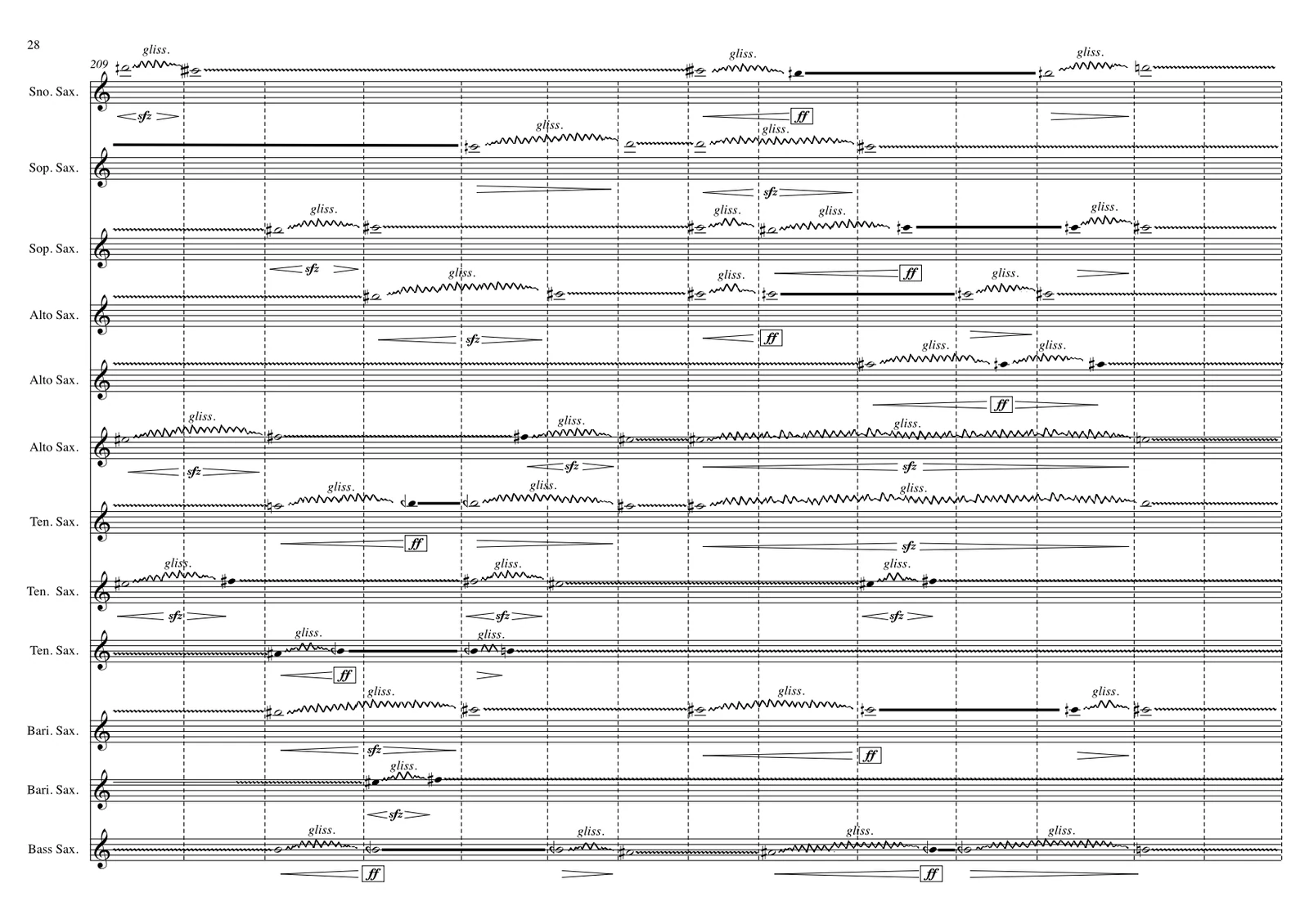
The most crucial element of this part is the vibrant, constantly fluctuating texture between the spectra of G#1 and A1. Based on a subjective perception of the “color” of notes in the chromatic scale, I consider G#1 as light blue and A1 as dark blue, with the midpoint between them representing International Klein Blue.
Thus, the spectra of G# and A are constantly superimposed, balanced in a fluctuating scale that shifts from one spectrum to the other until becoming the intermediate spectrum. This balance represents a constant struggle between the two colors within an intense, vibrant texture at a forte dynamic. The emergence of the International Klein Blue brings a point of repose, leading to the progressive disappearance of the spectrum into silence.
In space
Sounds deliberately move across the ensemble.
Echoing the performative nature of Action Painting, ‘Aktion’ treats the physical stage as integral; this spatial dimension is fundamental, making the live experience crucial to understanding the work as a dynamic sonic event unfolding in space.
More from Sound Lab
/ All works 2010Las MeninasFlute, clarinet, tenor saxophone, mezzo-soprano and viola. Commissioned by the Picasso Museum, Barcelona2025Promeno tra la merkatoElectroacoustic sound landscape2018 –Electroacoustic MiniaturesBrief electroacoustic sketches
 2011Berlin [bəɾsəˈɫonə]Audiovisual installation for three screens and electronics. Fundació Phonos, Barcelona